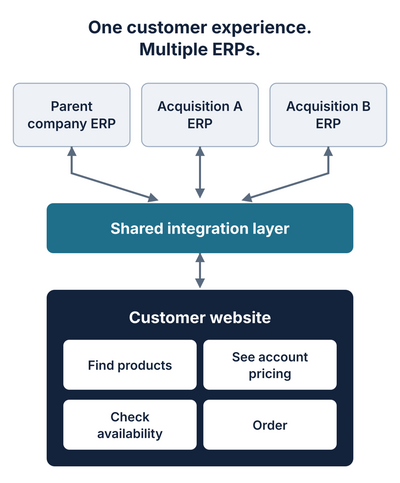
Customers can have one place to buy while the businesses still run on different ERPs.
The data layer we built was one approach, but there are others. They all start the same way: telling your systems implementer up front that you'll be integrating more than one ERP over time. Planning for more than one ERP takes some upfront work, but it can reduce how much you rebuild with each acquisition.
Why This Matters More Than Ever
Picture a buyer asking an AI assistant to find the replacement part that fits the machine they own, show them the price, and check whether it's in stock.
It brings to mind a technology I'm excited about called WebMCP because it could make tasks like this easier. It gives AI assistants a defined way to use functions on your site, such as looking up specs, checking availability, or adding items to a cart. Though your team will have to make those functions available because they don't happen on their own. WebMCP is still a proposed standard that is only available for experimentation in Chrome, so this isn't something to rush into this quarter, but it could be something to plan for.
For WebMCP and other tools to be useful, your site needs clean, structured product data with clear pricing and availability. All of which comes from your integrations. If an acquired company’s products, pricing, and availability aren't reaching your site, an agent won't find them. Connecting them now helps customers right away and builds the foundation for these tools later.
If you are thinking, “But we have customer-specific pricing,” so does nearly every B2B company that has hired us over the years. Tools like WebMCP don't rule this out, but when it's set up well, an assistant can use the buyer’s signed-in session to get their pricing, and your site can still enforce their account permissions.
Questions to Ask This Month
If you're growing through acquisition, you likely have companies on different ERPs. Pick one acquisition that's waiting on an ERP move and ask yourself:
- What can its customers not do online today?
- When is its ERP move realistically going to go live? Base this on how long your past ERP moves took compared to the plan.
- What would it take to let those customers do one valuable thing online now? How much of that work could be reused after the move?
Two Decisions, Not One
Yes, your ERP is central to running your business. But no, your acquisitions don't all need to be on the same ERP before their customers can get what they need from your site. The ERP migration date shouldn't be what decides when acquired customers get a better online experience. Show these answers to your implementer and ask them what it would take to connect that acquisition now.
Is an ERP move holding up your acquisitions' online progress? Reply and tell me what those customers aren't able to do. If your team has already decided to wait, or maybe decided not to wait, I'd like to hear how it went.