Why smart marketing teams are paying attention to Optimizely Opal right now
We were among the first cohorts to complete Opal University — Optimizely's inaugural AI training program. Here's what we actually think, and why it's different from the AI tools your team is probably already using.
There's a lot of noise in the AI space right now. Every tool claims to save you time. Every platform claims to be the future of work. Most of them are incremental improvements dressed up in big language.
Optimizely Opal is doing something genuinely different — and after several members of the Brilliance team completed the inaugural Opal University training program, we feel confident saying that.
One thing became clear almost immediately: Opal is not trying to be another chatbot.
The problem with most AI tools in a marketing context
Let's be honest about where general-purpose AI tools fall short. ChatGPT and Claude are genuinely excellent at helping individuals move faster on discrete tasks — drafting, summarizing, brainstorming, rewriting. If you're a solo operator or a small team, they're remarkable.
But when organizations try to use these tools at an operational level, cracks appear. You can't easily give them your brand voice, your governance rules, your existing workflow triggers, or your content approval process. Every time someone starts a new chat, they're starting from zero. There's no memory, no consistency, no institutional intelligence baked in.
AI becomes a personal productivity tool, but it never quite becomes an organizational capability. That's the gap Opal is designed to close.
What Opal actually is
Opal is Optimizely's AI platform — but calling it a chatbot or an AI assistant would miss the point entirely. It's better described as an agent orchestration platform: a system for building, governing, and chaining AI agents that can do real work inside real workflows.
During the Opal University training, we moved through everything from basic agent creation to more advanced capabilities: instruction design, multi-step workflows, schedulers, quality evaluations, and compliance checks. The use cases we saw in action covered a lot of ground that marketing and digital teams deal with every day.
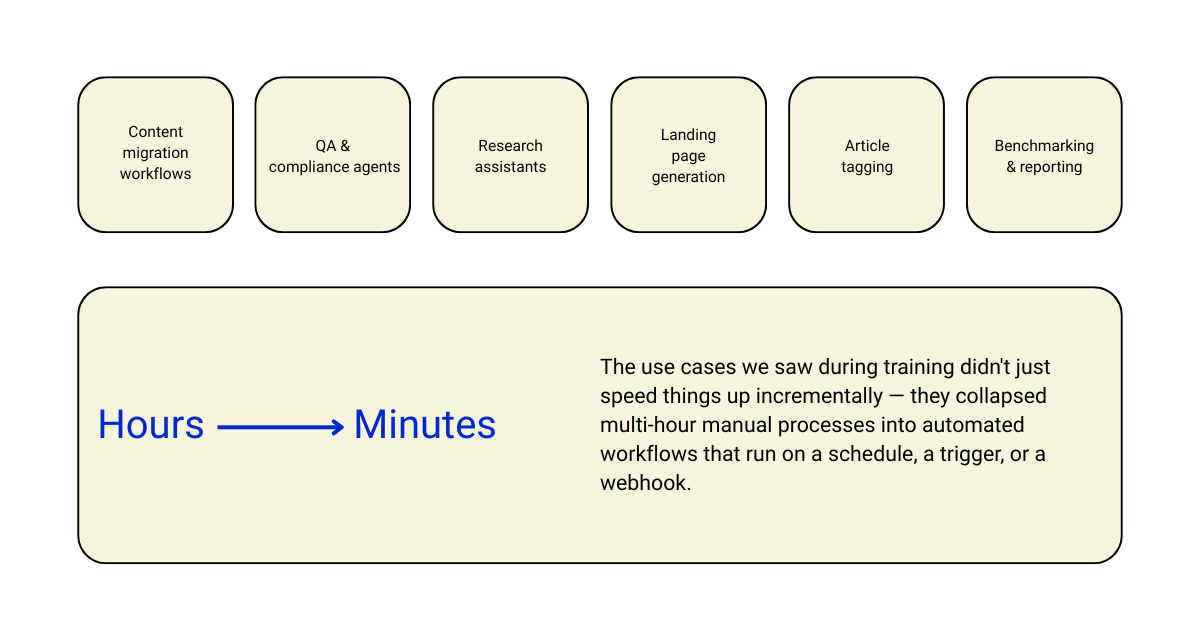
The key distinction is this: Opal agents don't just respond to a prompt. They can be triggered by a schedule, a webhook, an event, or another agent. They can connect to tools and data sources. They can be chained together into repeatable processes. And crucially, they can be informed by brand context, business rules, and performance data — not just whatever the user types.
Opal vs. traditional AI tools: the honest comparison
This isn't an either/or conversation. We use ChatGPT and Claude regularly — they're in our toolkit and they're not going anywhere. But they solve a different problem than Opal does.
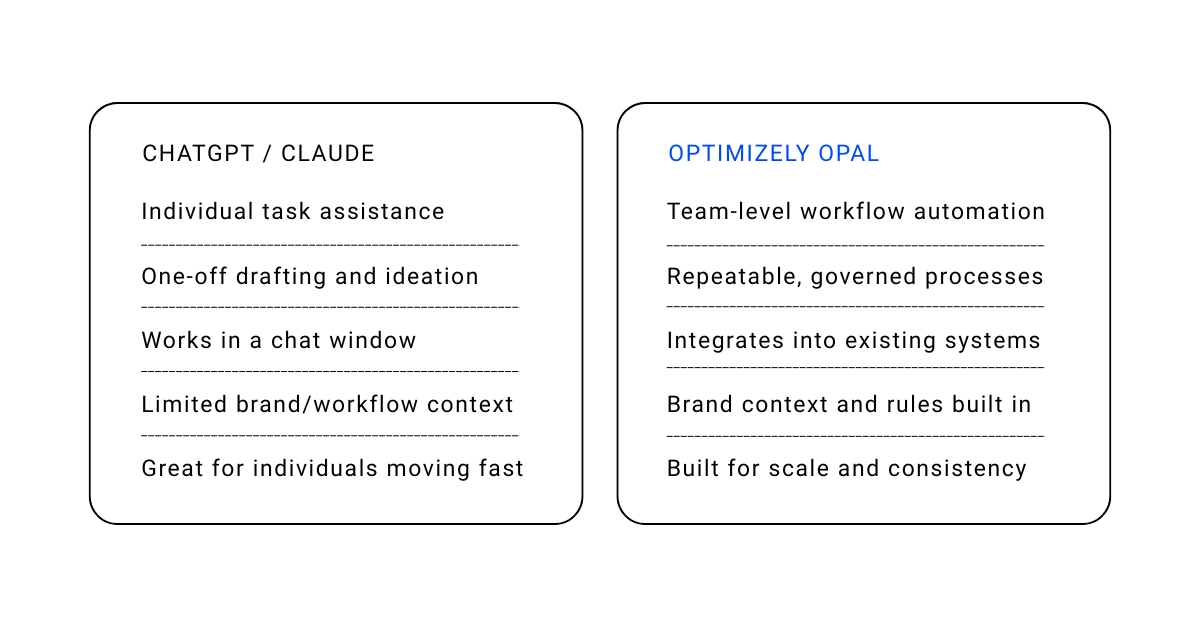
A simple way to think about it: ChatGPT or Claude can help you do a task. Opal is designed to help your team operationalize and scale that task — with governance, workflow integration, and brand context baked in from the start.
Who should be paying attention
If you're running a lean team doing mostly one-off content creation, Opal is probably more than you need right now. Stick with your current AI tools and get more out of them.
But if any of the following sounds familiar, Opal deserves a serious look: you're already on Optimizely and want AI that's native to your ecosystem. You have repetitive digital workflows — content tagging, compliance reviews, campaign setup, reporting — that consume significant team time. You've tried general AI tools for operational work and kept running into walls around consistency and governance. Or you want to build AI capabilities your whole team can use, not just power users comfortable prompting from scratch.
What we're building with it
As a digital agency, we're actively exploring Opal for content operations, experimentation planning, QA and compliance workflows, migration support, and insight generation. We're still early — but Opal University gave us a clear enough view of the platform's architecture that we're confident it's worth investing in.
The biggest unlock isn't generating content faster. It's removing the repetitive overhead that keeps smart people from doing the work that actually matters.
Final thought
Most AI tools are built for the individual. Opal is built for the team. That's a meaningful difference — and one that more marketing and digital leaders should be thinking about as they move from AI experimentation into AI operations.
We went through Opal University so you don't have to start from scratch. If you're curious whether Opal is the right fit for your team or your tech stack, we'd love to think it through with you.